

 ">
">

Buying an excavator auger is not simply about choosing the required hole diameter. The equipment needs to work as a complete drilling setup, with the carrier, hydraulic system, auger drive, and auger properly matched to the job. Ground conditions, drilling depth, and the type of cutting configuration also influence the selection.
Before comparing models or specifications, it helps to understand what you are actually buying. An auger setup consists of two main working components: the auger drive, which provides the rotational power, and the auger, which performs the cutting.
Drive vs. Auger—The Most Unknowingly Misused Terms
Auger drive (Earth Drill):
The auger drive is the powered unit. It connects to the excavator or another carrier and uses the machine’s hydraulic system to generate the rotational force required for drilling. Its specifications include hydraulic pressure, oil flow, torque, speed, weight, hub, and carrier size.
Auger:
The auger is the drilling tool attached to the drive. It contains components such as the tube, flights, pilot, teeth, and tooth holders that cut into the ground and bring spoil to the surface. Features such as tube construction, flight design, tooth retention, and pilot and tooth options therefore relate to the auger itself.
Before buying an excavator auger, check these five factors.
1. Check Compatibility With Your Carrier
Start with the machine you already have.
An auger attachment can be used with mini excavators, excavators, backhoe loaders, and skid steer loaders. But each machine has different hydraulic capabilities and can handle different attachment sizes.
Before choosing an auger drive, check:
- Machine size and weight
- Hydraulic oil flow
- Hydraulic pressure
- Required torque
- Attachment weight
- Hitch or mounting type
The drive should match what your machine can safely provide and carry. A bigger drive is not always better if your machine cannot operate it properly.
2. Match the Auger to the Ground Conditions
The ground makes a big difference to the auger you need.
An auger used for ordinary soil may not be the right choice for compacted ground or rock. The teeth and pilot need to suit the material being drilled.
For harder or fractured ground, a rock auger configuration may be more suitable. Different pilot and tooth options are available for different ground conditions, including Earth, Tungsten, Extra Dig, and Rock Pilots.
Before choosing the auger, ask:
- What type of ground will I be drilling?
- Is it soft, compacted, or rocky?
- How often will I use the auger?
- How hard is the material?
- What size hole do I need?
Knowing the ground conditions first makes it easier to choose the right cutting setup.
3. Confirm Hole Diameter and Drilling Depth
Next, think about the holes you actually need to drill.
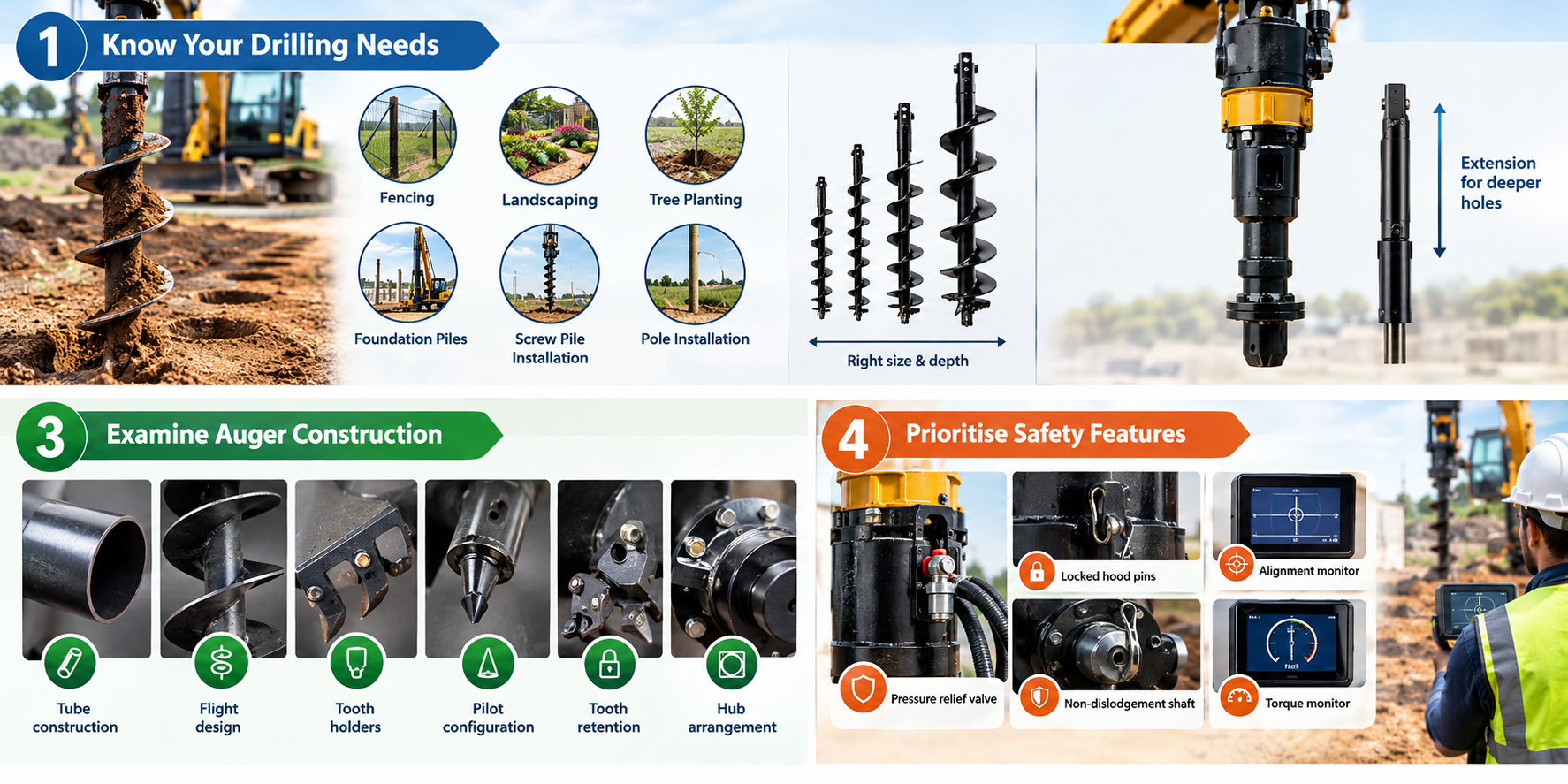
Different jobs require different diameters. Fencing, landscaping, tree planting, foundation piles, screw pile installation, and pole installation can all require different hole sizes.
The auger drive also needs to be suitable for the size of auger you plan to use.
Depth matters too. If you need to drill deeper holes, an extension may be required. Telescopic extensions are available for certain auger ranges and can provide additional drilling depth.
Do not choose an auger simply because it offers the largest possible hole. Choose one that suits the size and depth you regularly need.
4. Examine Auger Construction and Tooth Retention
The auger itself takes the cutting load, so its construction deserves close attention.
Look beyond the appearance and consider the components that directly affect drilling:
- Tube construction
- Flight design
- Tooth holders
- Pilot configuration
- Tooth retention
- Hub arrangement
The supplied material describes heavy-duty tubes made from high-grade steel, with tube size varied according to machine size and application. It also identifies shallow-pitch flights designed to retain spoil on the auger during removal from the hole.
Tooth retention is another practical consideration.
The Shock Lock tooth-locking system described in the supplied material uses a locking pin to secure the teeth in both directions.
The Constant Spiral Cut design positions the teeth so that each makes a fresh cut on every revolution, while directing spoil towards the centre to help avoid clogging.
These features matter because the cutting system needs to work consistently throughout repeated drilling operations.
5. Do Not Overlook Safety Features
Performance is important, but so is safe operation.
Look for features that help protect the drive and keep the attachment secure. The supplied equipment material includes a pressure relief valve designed to help prevent hydraulic overload and protect the motor. It also describes locked hood pins and a non-dislodgement shaft for added security.
Some applications may also benefit from monitoring equipment. An alignment monitor can provide the operator with information about drilling alignment, while a torque monitor can provide real-time torque data for applications where accurate installation matters.
You do not necessarily need every available feature. The important thing is to choose the features that make sense for the work you are doing.
Choosing an Auger Attachment From DOZCO
DOZCO has been involved in the construction and heavy equipment industry for more than 40 years, with its product range covering equipment and components used across demanding applications. Our auger solutions are built around the same basic consideration discussed throughout this guide.
For auger applications, DOZCO’s range includes Earth Drill models for different carrier sizes, from compact mini excavators to larger excavators. We have:
| Specification | X2500 | 3500 MAX | 4500 MAX | 5500 MAX | 7000 MAX | 8000 MAX | 25000 MAX |
|---|---|---|---|---|---|---|---|
| Machine Class | Mini Excavator 1–2.5 Tons |
Mini Excavator 2.5–4.5 Tons |
Skid Steer Loader | Mini Excavator 4.5–6 Tons |
Backhoe/Excavator 5–7 Tons |
Backhoe/Excavator 6–8 Tons |
Excavator 15–22 Tons |
| Oil Pressure Range | 70–240 Bar | 80–240 Bar | 80–240 Bar | 80–260 Bar | 80–260 Bar | 80–240 Bar | 160–240 Bar |
| Torque Range | 830–2847 Nm | 1205–3614 Nm | 1500–4499 Nm | 1685–5477 Nm | 2133–6931 Nm | 2717–8152 Nm | 1503–2475 Nm |
| Speed Range | 36–87 rpm | 43–81 rpm | 43–81 rpm | 30–87 rpm | 36–81 rpm | 33–70 rpm | 12–26 rpm |
| Weight | 48 kg | 75 kg | 75 kg | 108 kg | 112 kg | 115 kg | 269 kg |
| Recommended Drilling Diameter Range |
100–500 mm | 100–750 mm | 100–900 mm | 150–750 mm | 150–900 mm | 150–900 mm | 150–1200 mm |
They can also be configured with different hubs, pilots, and teeth for specific drilling requirements. This allows the drive and auger to be selected as a complete setup rather than as separate components.
Final Note
Excavator auger selection should make sense for the machine, the ground, and the work ahead. Start by checking the auger drive and carrier compatibility, then look at the auger’s diameter, depth, cutting configuration, and construction.
These details help determine whether the equipment is suited to the application rather than selected on specifications alone.
And, if you want to simplify the selection process, DOZCO brings together auger drives, auger options, and application-specific configurations, making it easier to find the right setup for your machine and drilling requirements.
FAQs:
1. How do I know which auger drive is right for my excavator?
Ans. Check your excavator’s operating weight, hydraulic oil flow, hydraulic pressure, attachment weight, and hitch type. The auger drive should fall within the machine’s operating capabilities and provide enough torque for the intended drilling work.
2. What type of auger should I use for rocky ground?
Ans. For hard or fractured ground, a rock auger configuration may be appropriate. The choice of teeth and pilot should match the ground conditions, as different cutting configurations are designed for different drilling requirements.
3. Do I need an extension for an excavator auger?
Ans. An extension may be needed when the required hole is deeper than the standard auger can reach. The appropriate extension depends on the auger range and the required drilling depth, so this should be confirmed when selecting the equipment.
4. Can one auger attachment be used for different ground conditions?
Ans. Not necessarily. Different ground conditions may require different teeth and pilot configurations. An auger used for ordinary soil may not provide the same results in compacted ground or rock, so the cutting setup should be selected according to the application.